
Buckeye, AZ · Garage Door Service
Garage Door Repair in Buckeye - When Heat, Not Age, Takes Out a Spring or Opener
Garage door repair in Buckeye, AZ for heat-cracked rollers, dried-out torsion springs, and opener failures common across this mostly post-2010 housing stock.
- Repairs & new doors
- Springs & openers
- Serving Buckeye & the metro
The Complications
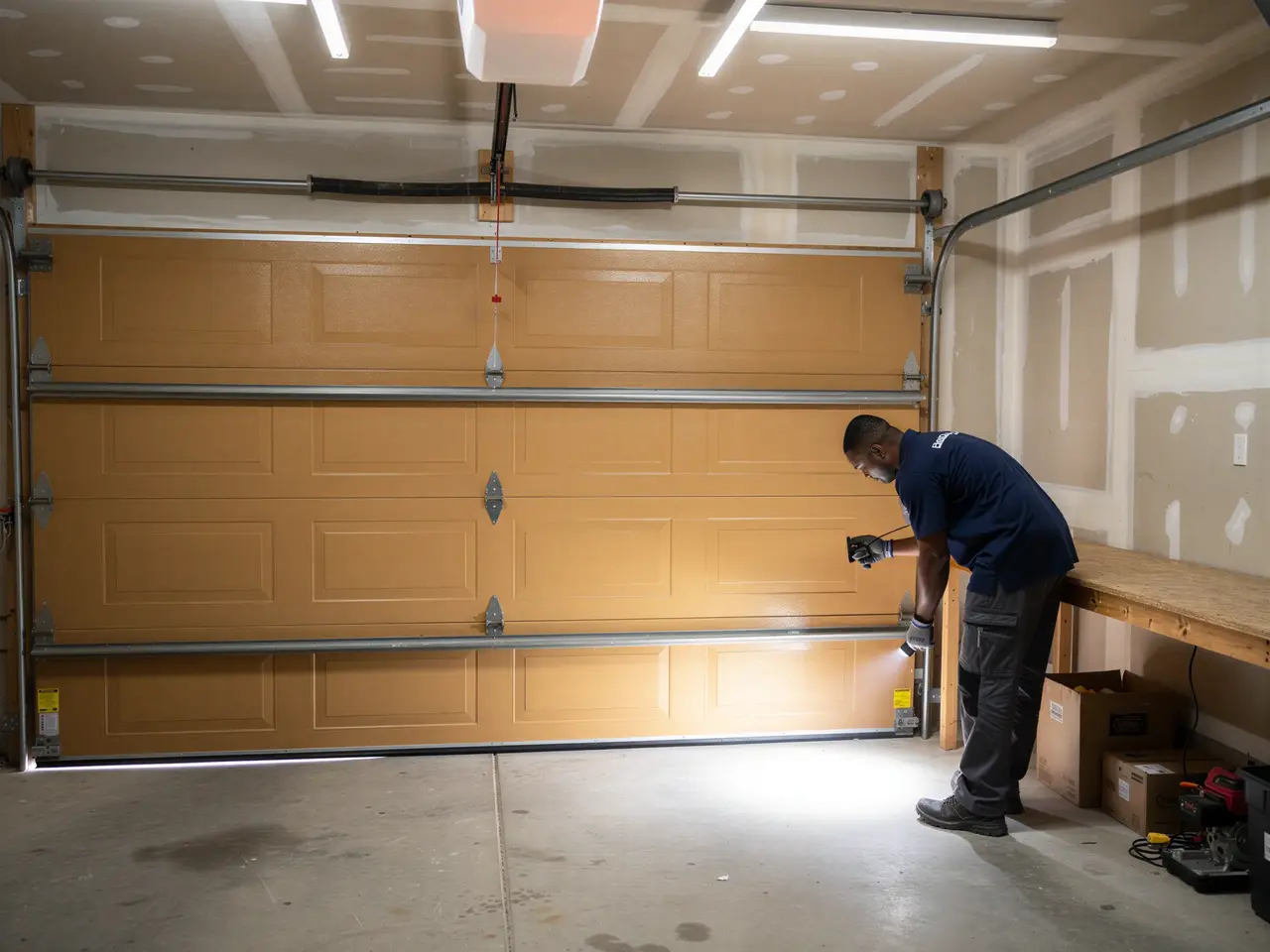
Most of the houses we'd be working on here went up after 2010, so you're not fighting rot in a wood jamb or a forty-year-old chain-drive opener with stripped gears from pure age. You're fighting a newer system that still fails, just for a different reason. Buckeye sits in a severe-heat climate band, and that heat is the complication running under almost every call. A torsion spring loses its temper faster when the garage regularly sits well above 100 degrees for months at a stretch. The grease that's supposed to keep the spring coils and the torsion bar moving smoothly cooks off and turns gummy, then dry. Nylon rollers and idler bearings get brittle and crack instead of wearing down gradually. Opener logic boards, especially units mounted on an uninsulated garage ceiling, run hotter than they were ever tested for, and that shortens the life of the capacitors inside. None of this shows up as rust or sag the way it would in an older, colder climate. It shows up as a door that worked fine yesterday and won't move today, or one that lurches instead of rolling smooth on the track.
The Cost of This Job
We're not going to put a number here we can't back up, because the right number depends on whether you're replacing one spring, a full torsion shaft, or a logic board on the opener - and those are three different jobs with three different parts lists. What we can tell you is how to think about it. With a median household income of $124,973 across this area, most of the owners we'd be quoting are deciding between a targeted repair and a full opener swap, not between a repair and doing nothing. That matters because a heat-damaged board is often cheaper to replace outright than to diagnose component by component. A spring job, by contrast, is usually a parts-and-labor call with a predictable scope once we're looking at the actual coil. The honest limitation: if the spring has already let go and the door dropped hard, we need to see what else it took out - track, cable, sometimes the bottom panel - before we can tell you what the job actually costs. We won't guess on the phone and we won't pad a quote to cover a guess.
Why This Fails Locally
This fault pattern is local to how Buckeye's housing stock meets Buckeye's climate, not something you'd see the same way everywhere. Because the stock here is mostly post-2010, the doors and openers are modern - insulated steel sections, drive systems with plastic drive gears, keypads with rubber seals. Those parts are built to handle normal wear, not a severe-heat band stacked month after month. The rubber seals around a keypad dry out and crack. The plastic drive gear inside a belt-drive opener, which is fine in a mild climate for a decade, softens slightly every summer and strips a few teeth at a time until one day it doesn't catch. A torsion spring rated for a certain number of cycles ages on a curve that's steeper when the garage runs hot most of the year. Across the roughly 1,915 owner-occupied houses in the 2,881 households in this service area, this is the pattern we see again and again: newer equipment, older-looking failure, because the failure mode here is heat fatigue, not wear from age.
What You Are Seeing
If the door groans, jerks, or hangs for a second before it moves, that's usually a spring that's lost tension unevenly - one side pulling more than the other. If the opener runs but the door doesn't move, or the motor hums and stalls, that's often a stripped drive gear or a belt that's slipped off its track, both more common once a garage has baked through a few summers. A door that reverses right after it starts closing is frequently a misaligned photo-eye sensor, sometimes just from the mounting bracket warping slightly in the heat. From West Phoenix Estates four miles WNW to Tartesso five miles NW, out toward Verrado nine miles ENE and the Verrado Main Street District eight miles ENE, we see the same handful of failure modes repeat, because the housing age and the climate exposure are consistent across that stretch. What we don't see much of here is the classic old-house problem - a door that's simply worn out from decades of use. Here, it's almost always heat that got there first.
Frequently asked questions
Why does my garage door opener keep failing even though the house is only a few years old?
Buckeye's severe-heat climate band is hard on opener electronics, especially units mounted on an uninsulated garage ceiling. The logic board and capacitors run hotter than they're rated for most of the year, which shortens their life regardless of how new the house is. It's heat fatigue, not a manufacturing defect or old age.
How do I know if it's the spring or the opener?
If the opener motor runs but the door barely moves or doesn't move at all, suspect the spring - it's lost tension and the opener can't lift the weight alone. If the motor itself hums, stalls, or doesn't engage, that points to the opener's drive gear or belt. We check both before quoting.
Is a dropped door always a spring problem?
Usually, but not always. A spring that lets go can also damage the track, a cable, or a bottom panel on the way down, depending on how the door was positioned when it failed. We won't quote a repair until we've actually looked at what else came off alignment.
Related services
By Neighborhood
Garage Door Repair across the Buckeye area
We also handle garage door repair in these Buckeye-area suburbs.
Book garage door service in Buckeye
Call now or request a quote - tell us what the door is doing and where you are.