
Buckeye, AZ · Garage Door Service
Emergency Garage Door Repair Across the Buckeye Service Area
Broken spring, dead opener, or a door stuck mid-track in Buckeye heat. See why this town's newer housing and severe summers cause specific, predictable failures.
- Repairs & new doors
- Springs & openers
- Serving Buckeye & the metro
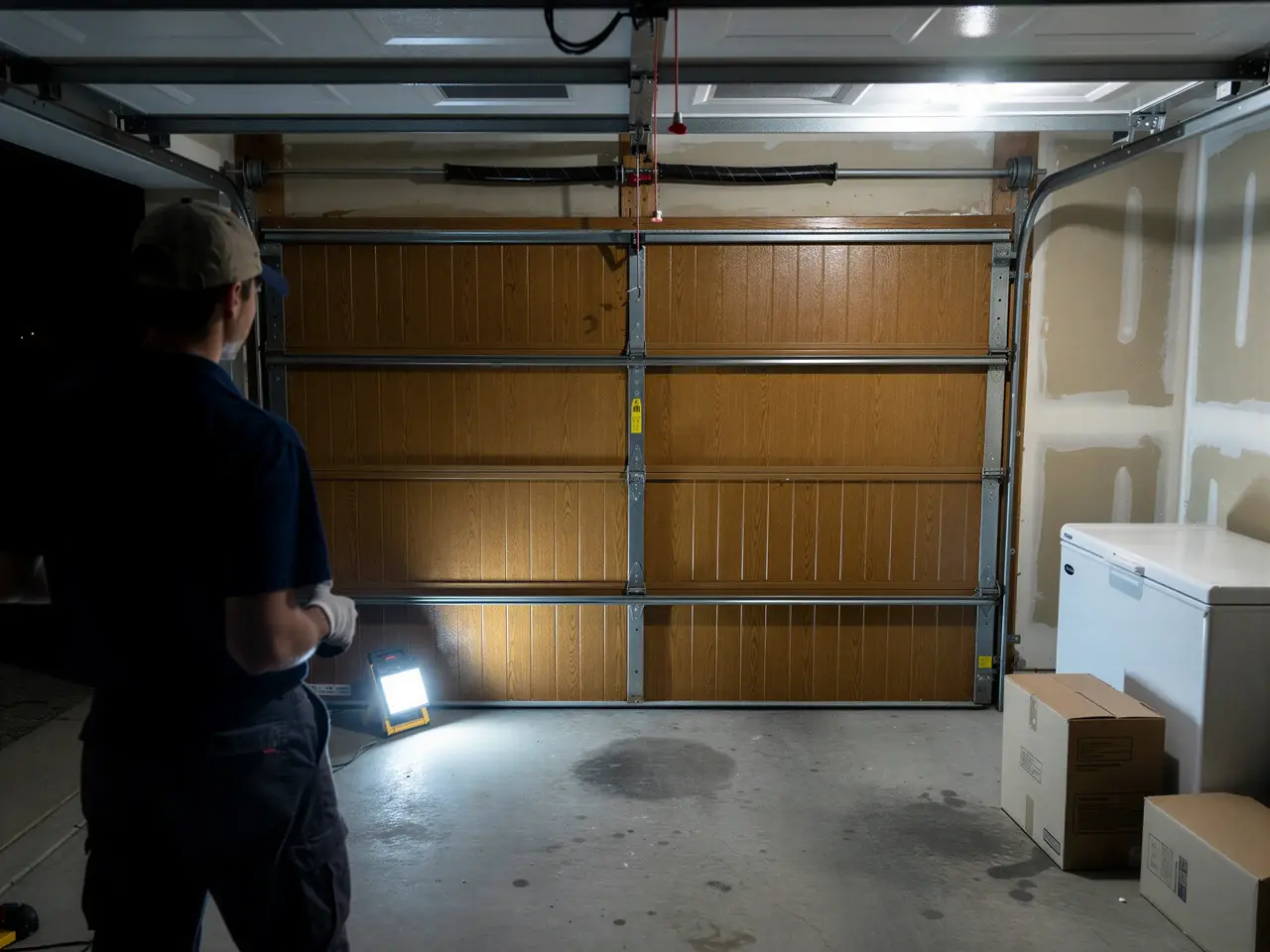
The Complications
A stuck or broken garage door at 6 a.m. doesn't wait for a convenient time, and in this part of the valley it rarely happens for a random reason. Most of the houses we're called to were built after 2010, which means the spring, drum, and opener hardware on them is largely the same generation of factory part - not a patchwork of decades-old replacements. That sounds like it should make repairs simpler, and it often does, but it also means when one door on a street fails from heat fatigue, several nearby doors of the same age and build are quietter but close behind.
The other complication is distance. The service area we run calls in stretches from communities like West Phoenix Estates and Tartesso a few miles out, through the Verrado districts to the east, and out toward Litchfield Park and Tonopah, each about 17 miles off. An emergency call isn't just about the part - it's about getting a truck to the right side of that spread before a door left half-open becomes a second problem: dust, heat, or an easy way in.
We don't carry every opener logic board or every spring wire gauge on the truck. If your opener is an uncommon model, a same-day fix might mean a temporary manual workaround while we source the exact part, and we'll tell you that up front rather than guess and reinstall twice.
The Cost of This Job
There's no single number that covers an emergency call, because a snapped cable and a dead opener logic board aren't the same repair, and we're not going to quote one here without a real figure behind it. What we can say is what drives the cost up or down in this area specifically.
Because most homes here are post-2010 builds, the hardware is more standardized than you'd find in an older neighborhood, and that keeps parts costs more predictable - we're not hunting down a spring size that stopped being manufactured years ago. What pushes cost the other direction is the heat. A spring that's cycled through repeated summer highs tends to go all at once rather than gradually, which often means the full assembly - spring, cable, sometimes the drum - needs replacing together rather than a single part swap.
Across the service area, median household income sits at $124,973, and in practice that shows up in the decision owners make at the point of repair: most choose a complete fix - new springs, new cable, inspected track - over a patch that buys a few more months. A quick patch on a door that's already fighting Buckeye summers usually just moves the emergency call to next July instead of avoiding it.
Why This Fails Locally
Buckeye sits in a climate band classified as severe heat, and that's not a side detail - it's the main reason emergency garage door calls here look different from calls in a milder market. A torsion spring is a piece of wound steel under constant tension, and steel under tension behaves differently at 115 degrees than it does at 70. Repeated heat cycling fatigues the metal faster, and openers with plastic gears or circuit boards mounted in an unconditioned garage take the same punishment.
Because most of the service area's houses - 1,915 owner-occupied houses out of 2,881 households total - went up on the same post-2010 building schedule, the failures cluster. We're not seeing a mix of 1960s extension springs next to 2015 torsion setups; we're seeing a tight band of similar torsion spring hardware and similar opener models, most of them now five to fifteen years into a summer-after-summer heat load they weren't necessarily rated to absorb indefinitely.
This is also why a repair that would be fine in a cooler climate - leaving a slightly undersized spring in place, for instance - doesn't hold up here. The margin for error shrinks every July, and a door that's borderline in spring tends to fail outright by August.
What You Are Seeing
The door won't open past a few inches, then stops hard. That's usually a broken torsion spring - the opener is trying to lift weight the spring should be carrying, and it can't. If you hear a bang from the garage before this happens, that's often the spring letting go.
The opener runs but the door doesn't move, or it hesitates and reverses partway. That points to the drive gear or the logic board, both of which take heat damage over seasons of attic-level garage temperatures. On post-2010 builds, these are usually a known opener model, which helps us move fast once we're on site.
The door drags, grinds, or comes off track slightly on one side. That's a roller or track alignment issue, sometimes made worse by thermal expansion in the track metal during peak heat. It's fixable, but if the track is visibly bent rather than just misaligned, replacement of that section beats trying to bend it straight - a bent track that's been forced back into shape tends to fail again, usually at a worse time.
Frequently asked questions
Why did my garage door spring break in summer and not some other time of year?
Torsion springs are wound steel under constant tension, and repeated heat cycling through Buckeye's severe-heat summers fatigues that steel faster than it would in a milder climate. A spring that's been slowly weakening for seasons often gives out completely once temperatures peak, which is why summer is when we get the most spring-failure calls.
Is my opener model going to be a problem to find parts for?
Usually not. Most homes in this service area were built after 2010, so opener models are fairly consistent across the area, which keeps common parts on hand. If you have an older or uncommon model, a logic board or gear replacement might take longer to source, and we'll tell you that before we start the job, not after.
My door is stuck halfway open - is it safe to leave it like that until you arrive?
If the spring has broken, the opener is unsupported and could drop the door further or strain the motor if someone tries to force it. Don't try to close or open it manually. Block the opening if you need security or shade in the meantime, and avoid running the opener again until the spring and cable are inspected.
Related services
By Neighborhood
Emergency Garage Door across the Buckeye area
We also handle emergency garage door in these Buckeye-area suburbs.
Book garage door service in Buckeye
Call now or request a quote - tell us what the door is doing and where you are.